Contoh Soalan MPT4 Sains / MPT4 Science Model Questions
Format Pentaksiran Sains MPT4 (Matriks Pembelajaran Tahun 4)
Pentaksiran Sains bagi Matriks Pembelajaran Tahun 4 (MPT4) dilaksanakan dalam bentuk ujian bertulis yang mengandungi pelbagai jenis item iaitu Objektif Aneka Pilihan (OAP), Objektif Pelbagai Bentuk (OPB) dan Subjektif Respons Terhad (SRT).
Bilangan soalan dibahagikan kepada:
- Bahagian A: 10 soalan
- Bahagian B: 2 soalan
- Bahagian C: 4 soalan
Jumlah markah keseluruhan ialah 50 markah
Tempoh ujian selama 1 jam 15 minit.
Pentaksiran ini menilai tiga konstruk utama iaitu:
- Mengetahui
- Mengaplikasi
- Menaakul
Cakupan ujian meliputi Standard Kandungan (SK) dan Standard Pembelajaran (SP) dalam DSKP KSSR Sains Tahun 1 hingga Tahun 4.
Aras kesukaran soalan adalah mengikut nisbah:
- Rendah: 50%
- Sederhana: 30%
- Tinggi: 20%
Kaedah penskoran yang digunakan ialah dikotomus dan analitikal.
Murid harus menguasai konsep asas Sains Tahun 1 hingga Tahun 4, terutama kemahiran memahami, mengaplikasi dan menaakul dalam pelbagai situasi.
MPT4科学评估格式
四年级学习矩阵(MPT4)的科学评估以书写测验形式进行,题型包括客观选择题(OAP)、多形式客观题(OPB)以及限定式主观题(SRT)。
题目数量分配如下:
A部分:10题
B部分:2题
C部分:4题
总分为50分
测验时间为1小时15分钟。
此评估考查三大主要构念,即:
认知(了解)
应用
推理
测验范围涵盖KSSR课程标准与评估文件中一年级至四年级科学的标准内容(SK)与学习标准(SP)。
题目难度比例如下:
低:50%
中:30%
高:20%
评分方式采用二分法(对/错)与分析法。
学生须掌握一至四年级科学的基本概念,尤其是理解、应用与推理能力在各种情境中的运用。
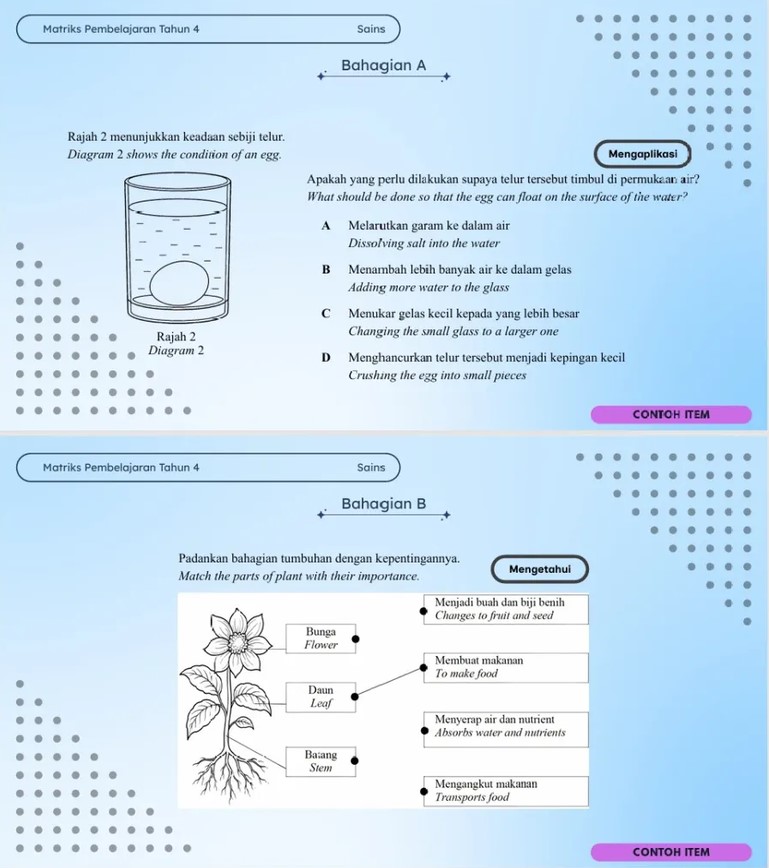

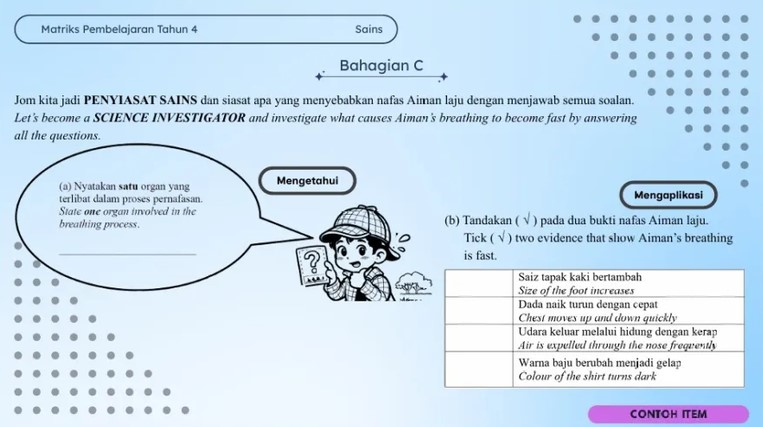
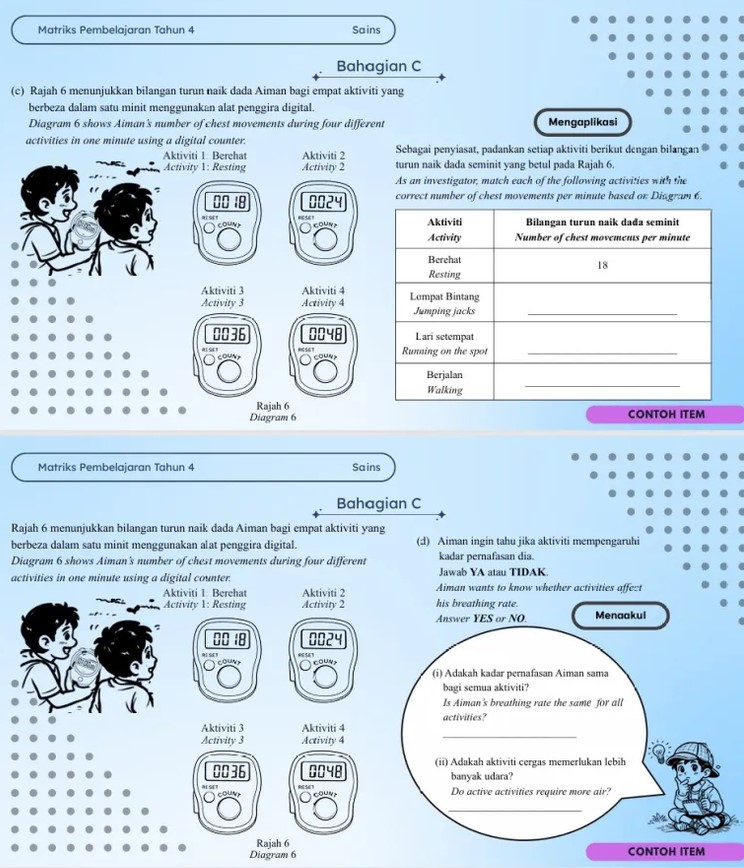
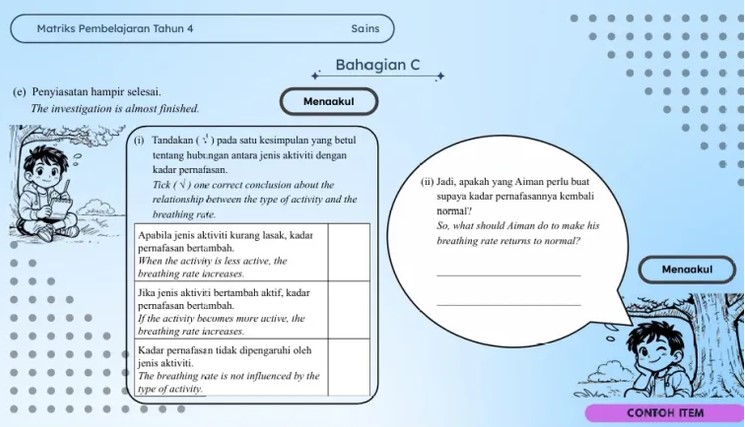
图1 —— C部分(推理:调查结论)
这道C部分题目以侦探人物阿伊曼(Aiman)呼吸调查为情境,要求学生从三个选项中勾选一个正确的结论,说明活动类型与呼吸速率之间的关系,并进一步说明阿伊曼应该怎么做才能让呼吸恢复正常。这类题目着重考查学生的推理能力,学生须根据已知资料进行逻辑推断,而非单纯背诵答案。此题型能有效训练学生从数据中归纳因果关系的思维能力。
图2 —— C部分(应用:图表数据分析)
这道题目呈现阿伊曼在进行四种不同活动(休息、跳跃星星、原地跑步、走路)时,利用数字计数器测量每分钟胸部起伏次数的图表数据,要求学生将每项活动与正确的次数配对,并进一步以”是”或”否”回答活动是否会影响呼吸速率,以及活跃的活动是否需要更多空气。此题型结合应用与推理两种能力,训练学生解读图表并进行科学判断。
图3 —— C部分(认知与应用:科学侦探情境)
此题以”成为科学侦探”的情境包装,引导学生调查是什么导致阿伊曼呼吸急促。第一小题考查认知能力,要求学生说出一个参与呼吸过程的器官;第二小题则考查应用能力,要求学生从选项中勾选两项能证明阿伊曼呼吸急促的证据,例如胸部快速起伏或经常从鼻孔喷出空气。这种情境式提问方式能提升学生的学习兴趣与参与感。
图4 —— B部分与C部分(植物生长顺序 / 呼吸情境)
B部分要求学生完成茄子植物生长阶段的顺序,从种子到幼苗、幼株,一直到结果的茄子植物,考查学生对植物生命周期的基本认知。另一题则以校园跑步情境呈现,两名男孩阿伊曼与朋友赛跑后气喘吁吁,透过对话引导学生思考呼吸急促与肩膀快速起伏之间的关联,为后续的推理题目做铺垫。
图5 —— A部分与B部分(鸡蛋浮力 / 植物部位配对)
A部分透过图表呈现一颗鸡蛋沉在水中的情况,要求学生从四个选项中选出能让鸡蛋浮上水面的正确方法,例如在水中溶解盐分,考查学生的应用能力。B部分则要求学生将植物各部位(花、叶、茎)与其功能配对,例如花朵变成果实与种子、叶片制造食物、茎部运输养分等,考查学生对植物结构与功能的基本认知。
Image 1 — Part C (Reasoning: Investigation Conclusion)
This Part C item uses a breathing investigation scenario involving a character named Aiman, requiring pupils to tick the correct conclusion about the relationship between activity type and breathing rate from three given options, followed by a question on what Aiman should do to return his breathing rate to normal. This item focuses on testing the reasoning construct, where pupils must draw logical conclusions from given information rather than simply recalling facts. It’s an effective way to build pupils’ skills in identifying cause-and-effect relationships from data.
Image 2 — Part C (Applying: Chart Data Analysis)
This item presents chart data showing Aiman’s number of chest movements per minute across four different activities — resting, jumping jacks, running on the spot, and walking — measured using a digital chest counter. Pupils are required to match each activity with the correct number of chest movements, then answer yes/no questions on whether activities affect breathing rate and whether active activities require more air. This item combines both applying and reasoning constructs, training pupils to interpret data and make scientific judgements.
Image 3 — Part C (Knowing & Applying: Science Detective Scenario)
This item is framed as a “Science Investigator” scenario, guiding pupils to investigate what causes Aiman’s breathing to become fast. The first question tests the knowing construct, asking pupils to state one organ involved in the breathing process, while the second tests applying, requiring pupils to tick two pieces of evidence showing Aiman’s breathing is fast, such as his chest moving up and down quickly or air being expelled through the nose frequently. This scenario-based approach helps boost pupil engagement and interest.
Image 4 — Part B & C (Plant Growth Sequence / Breathing Scenario)
Part B requires pupils to complete the sequence of growth stages of an eggplant, from seed to young plant to a fruit-bearing plant, testing basic knowledge of plant life cycles. Another item presents a school field scenario where two boys, Aiman and his friend, become breathless after a race, using dialogue to guide pupils toward reasoning about the link between fast breathing and rapid shoulder movement, setting up for a follow-up reasoning question.
Image 5 — Part A & B (Egg Buoyancy / Plant Parts Matching)
Part A presents a diagram of an egg sinking in water, requiring pupils to choose the correct method to make the egg float from four options, such as dissolving salt into the water — testing the applying construct. Part B requires pupils to match parts of a plant (flower, leaf, stem) with their functions, such as the flower changing into fruit and seeds, leaves making food, and the stem transporting food and nutrients — testing basic knowledge of plant structure and function.
Like this worksheet? Get the full PDF with answer key.
📥 Get full worksheet on Shopee